
The Philippine cryptocurrency market is rapidly growing and evolving, driven by increasing blockchain integration and strong public interest. As of 2024, the market was valued at nearly USD 50 billion and is projected to more than double to over USD 114 billion by 2033, with a compound annual growth rate of 9.68% through 2033. Growth is fueled by expanding adoption of cryptocurrencies for remittances, payments, trading, and investments, along with innovations such as play-to-earn metaverse platforms which have become popular sources of income, especially for lower-income communities. The growing digital financial ecosystem in the Philippines includes crypto lending, decentralized finance (DeFi) tools, and NFT trading.
Regulatory oversight is led primarily by:
This circular provides the regulatory framework for Virtual Asset Service Providers (VASPs) such as cryptocurrency exchanges and wallet providers. It requires VASPs to register with the BSP, maintain minimum capital requirements, implement anti-money laundering (AML) procedures, and ensure cybersecurity protections. This regulation treats cryptocurrencies as virtual assets and governs their legal use and trading within the country.
These new rules regulate Crypto-Asset Service Providers (CASPs) such as crypto exchanges and platforms that issue or trade crypto assets. The circulars require CASPs to register with the SEC, have physical incorporation in the Philippines, maintain a minimum paid-up capital of ₱100 million (approximately $1.8 million), separate customer assets from corporate funds, submit regular reports to the SEC and Anti-Money Laundering Council (AMLC), and comply with operational and marketing standards. Violations can result in fines up to ₱10 million or imprisonment up to five years.
Together, these laws provide a comprehensive regulatory environment designed to support innovation while ensuring investor protection, market integrity, and compliance with international anti-money laundering standards. The framework clarifies that cryptocurrency trading is legal but must be conducted only via licensed and compliant entities.
Additional oversight comes from:
This layered regulatory approach positions the Philippines as an emerging regulated market for cryptocurrencies in Southeast Asia.
The Philippine Securities and Exchange Commission (SEC) has banned ten major global cryptocurrency exchanges for operating without proper licenses. This enforcement follows the commission’s 2024 crackdown on Binance, marking the country’s most sweeping action against unlicensed crypto platforms so far.
On 1 August 2025, the SEC named
as banned entities. None held authorisation under the Philippines' Crypto Asset Service Provider (CASP) rules.
The SEC stated that these exchanges continued to target Filipino users through online channels despite lacking permission to operate locally. The ban echoes last year’s Binance incident, when users had 90 days to withdraw funds before access was shut down.
New regulations introduced in July require crypto providers:
Violations can lead to penalties of up to 10 million pesos per infraction, plus daily fines for ongoing breaches.
Following the ban, the SEC announced plans for a gradual rollout of access restrictions, and local telecom companies like PLDT and Smart have started blocking the affected exchanges. Regionally, Thailand and Indonesia are taking similar steps to restrict or tax unlicensed foreign crypto platforms.
The SEC warns that with the number of Filipino crypto users expected to top 12 million by 2026, reliance on illegal exchanges exposes consumers to high risks including platform collapse, fraud, money laundering, and data misuse. Only licensed operators can provide legal protection for user funds and comply with anti-fraud regulations.
There has been no official response from any of the banned exchanges so far. Analysts predict some may quit the market, while others could attempt to meet the stricter regulatory demands to regain access.
These are some key officially licensed cryptocurrency exchanges operating in the Philippines, providing regulated environments for crypto trading and integration with traditional financial services. The licensing under BSP’s VASP framework mandates compliance with regulatory standards, enhancing security and legal protections for users. This list reflects the current licensed exchanges landscape as of 2025.
Active Non-Bank VASPs, Active Bank VASPs, and Inactive or Non-Operational VASPs are categories defined by the Bangko Sentral ng Pilipinas (BSP) to classify Virtual Asset Service Providers (VASPs) in the Philippines based on their licensing status and operational activity.
Active Non-Bank VASPs are virtual asset service providers that have received official licenses from the BSP but operate independently of traditional banks. These entities provide crypto-related services such as trading, wallet provision, remittances, and crypto payments without being part of a banking institution. They must comply with BSP regulations including capital requirements, cybersecurity measures, and anti-money laundering (AML) obligations. They are fully operational and actively serve customers in the digital asset market.

Established as a pioneer in the Philippine crypto industry, Coins.ph obtained its VASP license in September 2017. It offers a variety of financial services including cryptocurrency trading, remittances, and bill payments. Popular cryptocurrencies like Bitcoin, Ethereum, XRP, and Bitcoin Cash can be traded on its user-friendly platform. Coins.ph has a strong market presence and celebrated 10 years in 2024 with record trading volumes.

Licensed by the Bangko Sentral ng Pilipinas (BSP) in May 2018, Bloomsolutions operates the BloomX platform. It is distinguished by its extensive crypto offering, trading over 250 cryptocurrencies, including Ethereum, Bitcoin, and Litecoin, focusing heavily on remittance services powered by blockchain technology.

DA5 runs the SurgePay wallet and received its VASP license on January 31, 2023. It is a hybrid digital wallet providing cryptocurrency trading (Bitcoin, Ethereum) alongside remittance and bill payment services. DA5 is noted for being highly licensed and trusted in financial services within the Philippines.

Formerly known as PayMaya, Maya expanded from payment services to become a fully licensed digital bank and crypto platform since receiving its VASP license on December 31, 2021. It offers cryptocurrency trading, micro-investments, and traditional financial services integrated into one ecosystem.

Licensed in early 2020, Moneybees facilitates over-the-counter crypto transactions via physical partner outlets and its online desk, focusing on Bitcoin, Ethereum, and USDT trades. It links digital currencies and cash to broaden crypto accessibility.

Since September 2018, PDAX has been one of the leading Philippine exchanges, enabling trading in more than 70 cryptocurrencies with Philippine peso integration. PDAX also powers the GCrypto platform tied to GCash and offers PDAX Prime for premium users with access to exclusive tokens.

TopJuan provides both business-to-business and consumer services through its TopWallet, a hybrid digital wallet supporting cryptocurrency trading alongside other financial products. It focuses on compliance and innovation in the local market.

As part of the Xendit Group, licensed as of January 31, 2023, XenRemit offers cryptocurrency trading integrated with remittance and bill payment services, leveraging Xendit's extensive payment infrastructure.
Active Bank VASPs similarly hold BSP licenses but are integrated within banking institutions. These bank-affiliated VASPs leverage existing banking infrastructure to offer cryptocurrency services while complying with stricter regulatory standards typical of banks, such as robust consumer protections and capital adequacy requirements. Their activity brings traditional banking stability and trust into virtual asset services, often combining conventional banking products with digital asset offerings.

Licensed in October 2024, GoTyme Bank is a digital bank jointly backed by Gokongwei Group and Singapore’s Tyme Group. It is known for innovative financial products including high-interest deposit accounts and USD trading options, actively expanding its presence in digital asset services.

UnionBank is the first local bank to secure a VASP license. It has been a pioneer in merging traditional banking and cryptocurrency services, continuing to lead in providing regulated and integrated digital financial solutions in the Philippines.
Inactive or Non-Operational VASPs refer to entities that hold licenses but have ceased active operations or business activities related to virtual assets. They might retain their licenses on paper but do not engage in transactions, trading, or wallet services. This status can result from various reasons, such as business discontinuation, regulatory non-compliance, or market exit. The BSP regularly updates its list to remove or flag these inactive providers to protect consumers and maintain market integrity.

Licensed on March 21, 2019, COEX Star aimed to integrate blockchain technology into environmentally sustainable agriculture and fisheries. Despite a relaunch effort in August 2022, it became inactive and was removed from BSP's list by January 2025.

WIBS PHP operated blockchain-based financial products including virtual currency exchange via its DO PAY platform. Despite initial activity, it ceased operations and was delisted by early 2025.

Juan Cash launched a mobile wallet and crypto trading platform targeting underbanked populations. Although it obtained licensing in 2018 and made a notable debut in 2019, it later discontinued operations and was declared inactive by 2025.
Looking ahead, the Philippines’ cryptocurrency market prospects remain strong with sustained adoption expected through growing metaverse engagement, enhanced blockchain use in finance and sectors like healthcare and supply chain, and continued innovation in remittance and payment solutions. The country’s digitally literate population and openness to crypto as an alternative financial ecosystem, combined with supportive regulation, position the Philippines as a leading crypto hub in Southeast Asia. Challenges will include managing regulatory compliance and ensuring consumer protection as the market matures.
Cryptocurrency exchanges in the Philippines are licensed and regulated as Virtual Asset Service Providers (VASPs) by the Bangko Sentral ng Pilipinas (BSP). You can find updated lists of registered VASPs on the BSP’s official website. Additionally, the Securities and Exchange Commission (SEC) is developing further regulations that expand its role in overseeing crypto exchanges to enhance consumer protection.
Yes, cryptocurrency trading is legal in the Philippines. The BSP's Circular No. 1108 provides regulatory guidelines for VASPs, treating cryptocurrencies as virtual assets. To operate legally, exchanges must register with the BSP. The SEC is also establishing licensing requirements to further regulate crypto trading entities.
To verify if a crypto exchange is regulated, you can:
Check the BSP website for a list of registered VASPs, though it may not be fully comprehensive.
Using regulated exchanges ensures better security for your assets, legal protections in case of disputes, compliance with anti-money laundering (AML) laws, and provides increased transparency and trustworthiness of the platform.
The main regulation framework includes BSP Circular No. 1108 that governs VASPs, requiring them to register, meet minimum capital requirements, and comply with AML and cybersecurity standards. In 2025, the SEC introduced additional rules governing Crypto-Asset Service Providers (CASPs), requiring physical incorporation, minimum paid-up capital of ₱100 million, asset segregation, and stricter reporting. These laws help safeguard consumers and maintain market integrity.
The government promotes innovation through regulatory sandboxes allowing testing of emerging blockchain and decentralized finance (DeFi) technologies. Public education campaigns raise awareness about scam prevention and responsible crypto usage. Updated taxation policies and marketing restrictions aim to balance growth with investor protection.
The Philippines is projected to experience significant growth in crypto adoption driven by its young, tech-savvy population, remittance use cases, and rising awareness of digital assets. Continued regulatory clarity, broadening financial services integration, and innovation in metaverse and DeFi sectors position the country as a leading Southeast Asian crypto hub.




 Bitcoin
BTC
Bitcoin
BTC
 Ethereum
ETH
Ethereum
ETH
 Tether
USDT
Tether
USDT
 Ripple
XRP
Ripple
XRP
 Binance Coin
BNB
Binance Coin
BNB
Gate is a full-service platform for exchanging digital assets. The exchange regularly ranks among the top ten cryptocurrency exchanges. Gate has undergone an audit confirming 100% proof of reserves. The company states that its security measures are among the best in the industry. Gate operates in most countries worldwide — more than 224 countries — and commits to complying with local laws and regulations.
More than 1,700 cryptocurrencies are available for trading, including Bitcoin, Ethereum, Litecoin, Dogecoin, and others. The platform also has its own GateChain token with a market capitalization of more than $130 million. Using the token can provide discounts on the platform. More than 350 trading pairs are available in total. According to CoinGecko, Gate ranks among the top five exchanges by trading volume.
Gate is an international cryptocurrency exchange founded in 2013 by Dr. Lin Han. The platform originally operated under the name Bter.com, and in 2017 the international version of Gate was launched.
Today, Gate operates through a group of companies and regional entities in different jurisdictions. The company does not officially identify a single location as its global headquarters. In Europe, Gate services are provided by Gate Technology Ltd, a company registered in Malta.

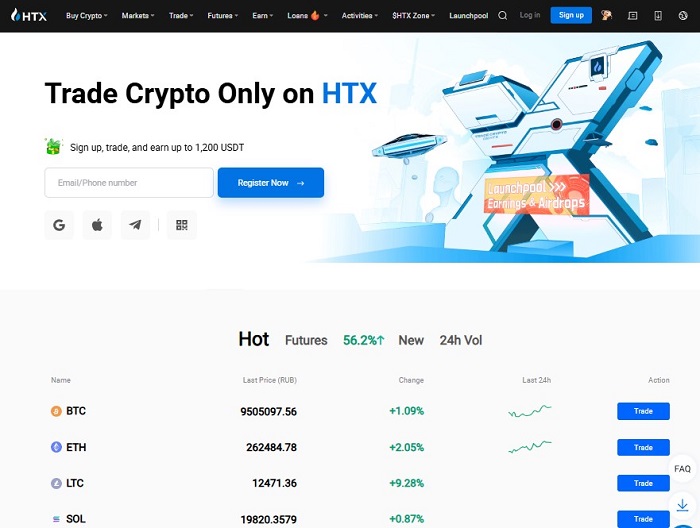
HTX is the rebranded version of the former Huobi cryptocurrency exchange. Huobi changed its name to HTX (Huobi Tron X) and underwent rebranding to mark its 10th anniversary in September 2023. The Huobi Exchange was founded in China in 2013 by Leon Li, who remains its current CEO.
The new name encapsulates several meanings: "H" stands for Huobi, "T" represents TRON (a decentralized operating system based on blockchain technology), and "X" signifies the exchange. Additionally, "X" symbolizes the decade-long journey of the exchange. The name HTX, when viewed as the combination of HT and X, indicates that HT is the platform's own token, with X representing exchange.
HTX ranks among the top 20 global crypto platforms in terms of market capitalization, liquidity, website traffic, and other rankings according to CoinGecko.
HTX is jurisdictionally based in the Seychelles (an offshore location) and operates offices in Singapore, Hong Kong, South Korea, Japan, and the United States. The exchange is accessible to residents of over 100 countries, including the Russian Federation (excluding Crimea and Sevastopol).
BingX is a cryptocurrency exchange that provides a platform for trading digital assets. Founded in 2018, it caters to traders interested in spot trading, futures trading, and social features such as copy trading. BingX allows users not only to trade cryptocurrencies but also to earn through staking and P2P trading.
BingX is an international exchange with licenses in multiple jurisdictions. The exchange is registered in Lithuania, with its headquarters located in Singapore. It is regulated in Lithuania and Australia, and its offices are spread across Asia, Oceania, Europe, and South America. BingX operates in over 100 countries worldwide.
Advantages:
Disadvantages:

