Date of publication: 04.06.2026 . Author: ploan.ph
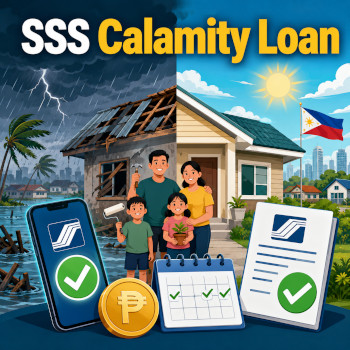 Table of Contents
The SSS Calamity Loan Program, or CLP, is a short-term loan facility for qualified SSS members affected by natural disasters.
It is designed for members who need cash after calamities such as:
The loan can help with recovery expenses, but it is still a loan. It must be repaid through monthly amortizations, and late payments can result in penalties.
.jpg)
| Item | Details |
|---|---|
| Loan type | Short-term calamity assistance loan |
| Best for | SSS members affected by declared calamities |
| Main condition | You must live or work in a covered State of Calamity area |
| Application channel | My.SSS website or SSS Mobile App |
| Loan amount | Based on one Monthly Salary Credit, capped at ₱20,000 under revised CLP guidelines |
| Interest rate | 7% per year under revised CLP guidelines |
| Repayment term | 24 monthly amortizations |
| Service fee | 1% of loanable amount under revised CLP guidelines |
| Release channel | UMID ATM card or PESONet bank account enrolled in DAEM |
| Key risk | Application may be rejected if your area, contributions, loan history, or account details do not qualify |
You may apply only if SSS has opened the Calamity Loan Program for your area.
In general, you must meet these conditions:
If you are employed, your employer must also be updated in the payment of SSS contributions and loan remittances.
Under the revised CLP guidelines announced by SSS, a member must generally have:
For self-employed, voluntary, non-working spouse, and land-based OFW members, SSS may also require at least 6 posted contributions under the current membership type before the month of application.
This matters for members who changed coverage type. For example, if you were previously employed but now pay as a voluntary member, SSS may check your contributions under your current membership type.
No. The SSS Calamity Loan is tied to an official State of Calamity declaration.
You cannot apply just because you personally need money after bad weather. Your area must be included in an active SSS Calamity Loan announcement.
Before applying, check:
If your area is not included, the application will not push through. You may need to check other options such as SSS Salary Loan, Pag-IBIG Multi-Purpose Loan, employer loan, cooperative loan, or licensed lenders.
The SSS Calamity Loan amount is based on your Monthly Salary Credit, not simply your current salary.
Under the revised CLP guidelines, the loanable amount is equivalent to one Monthly Salary Credit, computed based on the average of your last 12 Monthly Salary Credits, rounded up to the nearest thousand, or the amount you applied for, whichever is lower.
The loan is also capped at ₱20,000 under the revised CLP guidelines.
Example:
If your computed eligible amount is ₱18,000, you may borrow up to ₱18,000 before deductions. If your computed amount is ₱25,000, the loan may still be capped at ₱20,000.
Your actual net proceeds may be lower because SSS may deduct applicable fees, pro-rated interest, or balances depending on the program rules.
Under the revised SSS Calamity Loan Program guidelines, the interest rate is 7% per year.
The loan is payable within two years, or 24 equal monthly amortizations. The first amortization usually starts on the second month following the month of approval.
A 1% service fee may be deducted from the loan proceeds under the revised guidelines.
Late loan amortization may be charged a 1% penalty per month, computed for every day of delay. If the loan remains unpaid after the 24-month term, interest and penalties can continue until the loan is fully paid.
Older pages and older articles may still mention a 10% annual interest rate or different fee treatment. For this reason, always check the current SSS announcement or circular for the exact active loan window in your area.
SSS calamity loan proceeds are usually released through:
DAEM means Disbursement Account Enrollment Module. This is the My.SSS facility where you enroll the bank account or disbursement account that SSS will use to release loan proceeds.
If your DAEM account is missing, inactive, rejected, or not under your name, your loan release may be delayed even if your application is otherwise qualified.
The SSS Calamity Loan application is filed online through My.SSS or the SSS Mobile App.
Before doing anything else, confirm that your area is included in the active SSS calamity loan announcement.
Check the following:
Do not rely only on social media screenshots. Use official SSS announcements or confirm through your My.SSS account.
Use your My.SSS account to access the loan application facility.
If you do not have an account yet, register first. You need My.SSS access because SSS calamity loan filing is handled online.
Before applying, check that your:
Review whether you have:
Do not count payments that are not yet posted in the SSS system. What matters is what appears in your SSS record.
Before applying, check if you have:
A past due loan can block your application.
Go to the DAEM section in My.SSS and confirm that your disbursement account is active and accepted.
The account should be:
If the account is incorrect, fix it before applying.
Inside My.SSS or the SSS Mobile App, go to the loan application section and choose the Calamity Loan option if it is available for your account and area.
Review:
Submit only after checking the details.
If you are employed, your employer may need to certify your loan application.
The employer confirms that:
If your employer does not certify the application, processing may be delayed.
After approval, SSS releases the proceeds through your registered disbursement channel.
Processing time may vary depending on:
Do not submit repeated applications without checking the status of the first one.
To check your status:
If you are employed and the status is not moving, ask HR or payroll if employer certification has already been completed.
SSS loan payments use the Payment Reference Number, or PRN.
For employed members, payment is usually handled through salary deduction and employer remittance.
For self-employed, voluntary, non-working spouse, and OFW members, you need to pay using the correct PRN through accepted SSS payment channels.
Always check payment posting in My.SSS. A payment deducted from salary or paid through a channel should still appear correctly in your loan record.
For employed members, the employer has an important role.
The employer may need to:
If your employer is not updated in contribution or loan remittance payments, your application may be affected.
As the borrower, you should:
Even if your employer handles deductions, you should still monitor your My.SSS loan record.
Common reasons include:
Before reapplying, identify the actual reason. Repeating the same application without fixing the problem will not help.
These two loans are often confused.
| Feature | SSS Calamity Loan | SSS Salary Loan |
| Main purpose | Assistance after declared calamity | General short-term cash need |
| Availability | Only for covered calamity areas and periods | Available to qualified members generally |
| Main trigger | State of Calamity declaration | Member’s contribution eligibility |
| Loan amount | Based on one Monthly Salary Credit, capped under CLP rules | One-month or two-month salary loan depending on contributions |
| Repayment | Usually 24 months | 24 months |
| Application | My.SSS or SSS Mobile App | My.SSS or SSS Mobile App |
| Best for | Disaster recovery expenses | Bills, school expenses, medical needs, cash shortage |
If your area is not covered by the Calamity Loan Program, check whether you qualify for an SSS Salary Loan instead.
After a disaster, some people need money quickly and consider online lending apps. These may be faster in some cases, but the total cost can be much higher.
| Criteria | SSS Calamity Loan | Private online loan |
| Who can apply | Qualified SSS members in covered calamity areas | Depends on lender |
| Cost | Structured SSS interest and fees | Can be high, depending on lender |
| Loan amount | Based on SSS records and CLP cap | Based on lender assessment |
| Release | Through SSS-approved disbursement channels | Depends on lender |
| Main advantage | Government-backed calamity assistance | Possible faster access |
| Main risk | Not available if area or records do not qualify | High fees, penalties, or aggressive collection if lender is not reputable |
If you use a private lender, check whether it is registered, compare the total repayment amount, and read the penalty terms before applying.
If you are not qualified for the SSS Calamity Loan, check the reason first.
You cannot use the SSS Calamity Loan if your area is not included in the active program. Consider SSS Salary Loan, Pag-IBIG Multi-Purpose Loan, employer assistance, cooperative loan, or other legal options.
Continue paying contributions and wait until you meet the minimum requirement. If you are employed, check whether your employer has remitted your contributions correctly.
Update or re-enroll your disbursement account in My.SSS before applying again.
Follow up with HR or payroll. For employed members, employer certification can be the reason the application is stuck.
Check your loan balance and payment options. A past due loan may need to be settled or updated before you can apply again.
You may also check:
Avoid unregistered lenders and informal loan sharks. During disasters, fast cash with unclear charges can create a bigger financial problem.
Avoid these mistakes when applying:
Before submitting your SSS Calamity Loan application, check:
The SSS Calamity Loan is a short-term loan for qualified SSS members who live or work in areas officially declared under a State of Calamity.
Qualified SSS members may apply if they live or work in a covered calamity area, have enough posted contributions, are registered in My.SSS, have no disqualifying loan problems, and meet the other SSS conditions.
Under the revised CLP guidelines, members generally need at least 36 posted monthly contributions, with at least 6 posted within the last 12 months before the month of filing. Individually paying members may also need 6 posted contributions under the current membership type.
No. The SSS Calamity Loan is available only for areas covered by an official State of Calamity declaration and an active SSS calamity loan announcement.
The loan amount is based on one Monthly Salary Credit computed from your recent SSS records and is capped at ₱20,000 under the revised CLP guidelines.
Under the revised SSS Calamity Loan Program guidelines, the interest rate is 7% per year. Check the active SSS announcement for your area because older pages and past programs may show different rates.
The loan is payable in 24 monthly amortizations. The first amortization usually starts on the second month after loan approval.
Log in to My.SSS or use the SSS Mobile App, check if the Calamity Loan option is available for your account and area, review the loan details, and submit the application. If employed, wait for employer certification.
DAEM means Disbursement Account Enrollment Module. It is the My.SSS facility where you enroll the account that SSS will use to release your loan proceeds.
Land-based OFW members may apply if they meet the contribution requirements, current membership-type requirement, My.SSS registration, DAEM, and area coverage rules.
Common reasons include uncovered area, insufficient contributions, no recent contributions, past due SSS loan, outstanding restructured loan, inactive DAEM account, employer non-certification, outdated records, or age ineligibility.
It depends on your loan standing. If your existing loan is past due or disqualifying, your application may be rejected. If your loan is updated and you meet all other conditions, SSS will assess your eligibility.
Under revised CLP guidelines, renewal may be allowed after six months if the existing calamity loan is not past due. The exact rules may depend on the active SSS announcement.
Check the reason first. You may need to update contributions, fix DAEM, settle past due loans, wait for area coverage, or consider other legal options such as SSS Salary Loan, Pag-IBIG loans, employer assistance, cooperative loans, or licensed lenders.
Interest |
Loan amount |
Term |
Borrower age |
SEC registered |
||
|---|---|---|---|---|---|---|

|
APR 145%
|
₱500 — ₱20,000
|
from 3 to 6 months
|
22+ years
|
SEC Registration number: CS201953073., Certificate of Authority №1254
|
|

|
from 0%
|
₱1,000 — ₱50,000
|
up to 12 months
|
20 — 70 years
|
SEC Registration No. CS201908275 SEC Certificate of Authority No. 1324
|
|

|
APR 143% per year
|
₱1,000 — ₱20,000
|
from 61 to 183 days
|
22 — 70 years
|
Registration № CS201726430, CA №1181
|
|