Date of publication: 08.06.2026 . Author: ploan.ph
 Table of Contents
A Pag-IBIG loan calculator is a tool that helps estimate possible loan figures, such as:
For housing loans, Pag-IBIG has an official Housing Loan Affordability Calculator. It lets users compute either the income needed for a desired loan amount or the possible loan amount based on income.
For cash loans, such as the Pag-IBIG Multi-Purpose Loan, there is no single universal calculator that can guarantee your exact proceeds. You can still estimate the possible amount using your Pag-IBIG Regular Savings, current loan balance, and repayment term.
A calculator may be useful for different Pag-IBIG loan types, but the calculation method is not the same for each one.
| Loan type | What you can estimate | Main basis |
|---|---|---|
| Pag-IBIG Housing Loan | Loan amount, monthly amortization, income required, affordability | Income, interest rate, loan term, appraisal, property value |
| Pag-IBIG Multi-Purpose Loan | Possible loanable amount and rough monthly payment | Total Pag-IBIG Regular Savings and existing loan balance |
| Pag-IBIG Calamity Loan | Possible loanable amount and payment estimate | Regular Savings, calamity loan rules, existing loans |
| Health and Education Loan Programs | Possible amount and payment estimate | Program rules, savings, eligibility |
The most common calculator search is for housing loans because home loans are larger, longer, and more sensitive to interest rate and loan term.
The official Pag-IBIG Housing Loan Affordability Calculator is mainly for home financing estimates.
It can help answer two common questions:
This is useful if you are planning to buy a house, condominium, residential lot, or property through a developer and want to know whether the monthly payment may fit your budget.
However, the result is only a guide. Pag-IBIG still needs to evaluate your actual documents, income, membership status, loan purpose, property value, and other requirements.
Official Pag-IBIG Housing Loan Affordability Calculator
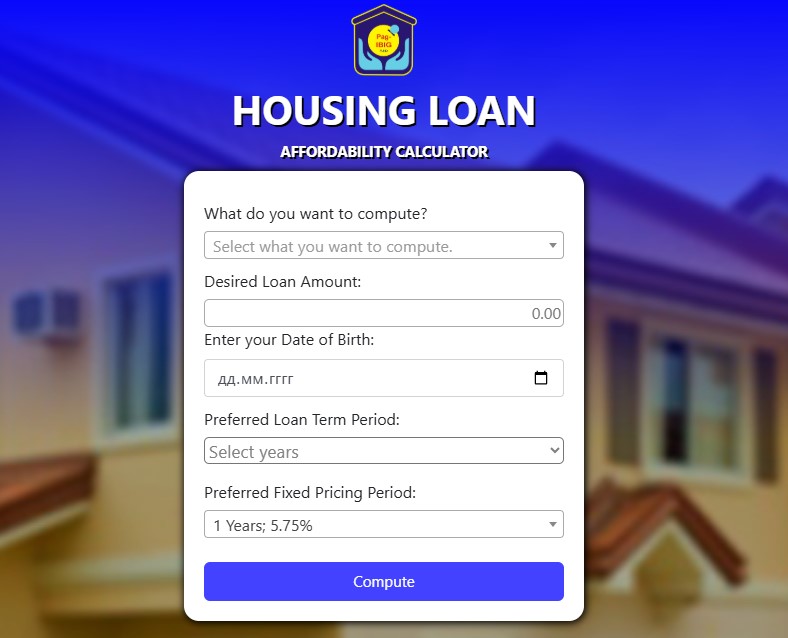
Before using a Pag-IBIG housing loan calculator, prepare these details:
For better estimates, do not use your ideal figures. Use realistic figures based on payslips, actual income, existing expenses, and the property price you are considering.
The official calculator usually gives two main options:
Choose the first option if you already know the property price or target loan amount.
Choose the second option if you are still checking what property price range may fit your income.
Gross monthly income means your income before deductions.
For employed workers, this may include basic salary and regular allowances, if acceptable to Pag-IBIG.
For self-employed applicants, use income that you can prove with documents such as tax returns, financial statements, business records, bank statements, or other accepted proof.
For OFWs, use income that can be supported by employment contracts, certificates of employment, or other documents accepted by Pag-IBIG.
Do not enter an income amount that you cannot prove. Pag-IBIG will not rely only on what you type into the calculator.
The loan term affects the monthly payment.
A longer term gives a lower monthly amortization, but you pay for more years. A shorter term gives a higher monthly amortization, but you finish the loan faster.
Pag-IBIG housing loans may allow long repayment terms, but the term still depends on the borrower’s age and approval. A borrower close to the age limit may not qualify for the longest term.
Housing loan interest depends on the applicable Pag-IBIG rates and the fixing or repricing period.
A shorter fixing period may have a lower starting rate, but your rate can be repriced sooner. A longer fixing period may offer more payment stability, but the rate can be higher.
For example, public Pag-IBIG announcements in 2025 mentioned standard housing loan rates starting from 5.75% per year for a one-year repricing period and 6.25% for a three-year repricing period. Qualified socialized housing borrowers under specific government housing programs may have access to subsidized rates, such as 3% per year.
Always check the current Pag-IBIG rate table before relying on a calculation.
After entering the details, the calculator shows an estimate.
Use the result to check:
Do not treat the result as final approval.
Here is a simple example for understanding only.
Suppose you want to buy a property and borrow ₱2,000,000.
Your estimate will depend on:
A longer term, such as 25 or 30 years, may reduce the monthly amortization. A shorter term, such as 10 or 15 years, may increase the monthly amortization but reduce the total interest paid over the life of the loan.
The calculator can help compare these scenarios before you apply.
The calculator result may be higher than the actual approved loan amount.
This can happen if:
This is why a calculator should be used for planning, not as a promise.
Many Filipinos also search for a Pag-IBIG loan calculator because they want to know how much they can borrow through the Pag-IBIG Multi-Purpose Loan, or MPL.
The MPL is different from a housing loan. It is a short-term cash loan based mainly on your Pag-IBIG Regular Savings.
After the 2025 enhancement, qualified members may borrow up to 90% of their total Pag-IBIG Regular Savings, subject to Pag-IBIG assessment and deductions.
Your Regular Savings generally include:
Use this rough formula:
Estimated maximum MPL = Total Pag-IBIG Regular Savings × 90%
Example:
If your total Pag-IBIG Regular Savings is ₱40,000, your possible maximum loan entitlement may be:
₱40,000 × 90% = ₱36,000
But this is not necessarily the amount you will receive.
Your net proceeds may be lower if:
The Pag-IBIG Multi-Purpose Loan has a monthly interest rate commonly stated at 1.4583% under the enhanced MPL program.
Your actual monthly amortization depends on:
The enhanced MPL also introduced repayment term options such as 1 year, 2 years, and 3 years.
In simple terms:
If your budget is tight, a longer term may feel easier monthly, but you should still check the total repayment obligation.
Suppose your estimated loan amount is ₱30,000.
Your monthly payment will vary depending on the term:
| Term | Monthly payment effect | Best for |
| 1 year | Highest monthly payment | Borrowers who want to finish fast |
| 2 years | Moderate monthly payment | Borrowers who want balanced repayment |
| 3 years | Lowest monthly payment among the three | Borrowers who need lighter monthly amortization |
This table does not replace Pag-IBIG’s official computation. It only shows how term length affects affordability.
A Pag-IBIG Calamity Loan is also based on member eligibility and Regular Savings, but it is available only for members affected by a declared calamity.
You cannot use a calamity loan calculator unless your area is covered by a state of calamity and Pag-IBIG has opened the program for affected members.
When estimating, check:
If your area is not covered, check the Multi-Purpose Loan instead.
These two calculations are very different.
| Feature | Housing Loan Calculator | MPL Estimate |
| Main use | Home purchase, construction, renovation, refinancing | Short-term cash needs |
| Main basis | Income, property value, interest rate, term | Pag-IBIG Regular Savings |
| Loan size | Usually much larger | Usually smaller |
| Repayment | Long-term monthly amortization | Short-term monthly amortization |
| Collateral | Property is usually used as collateral | No real estate collateral for standard MPL |
| Calculator accuracy | Still subject to appraisal and approval | Still subject to account assessment and deductions |
If you are buying a home, use the housing loan calculator.
If you need cash for personal expenses, estimate based on Regular Savings and MPL rules.
A calculator result is not a loan approval. Pag-IBIG still evaluates your eligibility, income, documents, property, and loan history.
Some calculators ask for gross monthly income. If you enter the wrong type of income, the result may be misleading.
Even if your income looks enough, existing debts can reduce your real capacity to pay.
For housing loans, the property selling price and appraisal value may not be the same. If the appraisal is lower, the approved loan may be lower.
A longer term lowers monthly amortization but may increase total interest cost. It is not always the best choice.
Housing expenses are not limited to monthly amortization. You may also need to prepare for:
Pag-IBIG rates may change. Always check current rates before applying or making a final decision.
For the Multi-Purpose Loan, the 90% figure is based on Regular Savings, but existing loan balances and deductions can reduce actual proceeds.
A loan may be approved but still feel heavy for your household budget.
Before applying, check if you can still pay for:
For a housing loan, avoid using all available income for amortization. Homeownership also brings maintenance and repair costs.
For a cash loan, avoid borrowing the maximum amount if your salary or business income is unstable.
Use a calculator before:
A calculator is most useful before you commit money to a property or loan plan.
After getting an estimate:
Do not stop at the calculator result. Use it as the first screening tool.
If you are buying a property, compare Pag-IBIG with bank home loan calculators.
| Criteria | Pag-IBIG Calculator | Bank Loan Calculator |
| Best for | Pag-IBIG members checking home loan affordability | Borrowers comparing bank financing |
| Main inputs | Income, loan amount, term, interest rate | Loan amount, term, bank rate |
| Approval basis | Pag-IBIG membership, income, appraisal, documents | Bank credit standards, income, appraisal |
| Term | May allow long terms, subject to age and approval | Depends on bank |
| Rate | Depends on Pag-IBIG rate table and fixing period | Depends on bank offer |
| Best use | First estimate for Pag-IBIG home financing | Comparison with private bank offers |
Do not compare only the monthly payment. Also compare total interest, fixing period, repricing risk, fees, insurance, processing time, and property requirements.
No. A calculator cannot fully determine approval.
Pag-IBIG may still review:
For cash loans, Pag-IBIG will also check your Regular Savings and existing loan balances.
Pag-IBIG Housing Loan Affordability Calculator. This is the official Pag-IBIG calculator, but exclusively for Housing Loans. It estimates required income, possible loan amount, monthly amortization, and other indicative figures.
Virtual Pag-IBIG — Apply for and Manage Loans. The official portal section providing access to Short-Term Loan, Housing Loan, Home Equity Appreciation Loan applications, as well as tools to check your loan status and manage other loan services.
Virtual Pag-IBIG — Short-Term Loan Application. STLApplication.aspxThis is not a calculator, but the official application form for short-term loans. On this page, you can select the type of loan; options such as MPL (Multi-Purpose Loan) and Calamity Loan are displayed in the list.
Virtual Pag-IBIG — Short-Term Loan Reminder / Requirements. An official page listing requirements before submitting a short-term loan application: loan application form, valid ID, cash card, selfie photo.
Virtual Pag-IBIG — Loan Status Verification. The official page for verifying the status of your Housing Loan, Multi-Purpose Loan, or Calamity Loan.
Virtual Pag-IBIG — Pay Online: Multi-Purpose Loan. The official online payment page for Multi-Purpose Loans.
Virtual Pag-IBIG — Pay Online: Calamity Loan. The official online payment page for Calamity Loans.
A Pag-IBIG Loan Calculator is a tool that helps estimate possible loan amount, monthly amortization, income requirement, or affordability for Pag-IBIG loans. It is most commonly used for housing loans.
Pag-IBIG has an official Housing Loan Affordability Calculator for home loan estimates. It helps users check either the income needed for a target loan amount or the possible loan amount based on income.
No. The result is only an estimate. Pag-IBIG still needs to evaluate your documents, income, membership, contributions, property, appraisal, and loan history.
A rough estimate is your total Pag-IBIG Regular Savings multiplied by 90%. For example, if your Regular Savings is ₱40,000, the possible maximum entitlement may be around ₱36,000 before deductions and assessment.
Your actual loan may be lower because of existing loan balances, deductions, income limitations, property appraisal, incomplete documents, age limits, or Pag-IBIG evaluation results.
You need your gross monthly income, desired loan amount, loan term, interest rate or repricing period, property price, age, and existing debt obligations.
Monthly amortization is the amount you pay every month for the loan. It usually includes principal and interest. For housing loans, insurance and other charges may also affect the total payment.
Not always. A longer term lowers monthly payments but can increase total interest paid over time. A shorter term costs more monthly but may reduce total interest.
Yes. OFWs can use the calculator for estimates, but actual approval still depends on Pag-IBIG membership, income documents, property requirements, and eligibility.
Yes. This is one of the best uses of the calculator. It helps you estimate what property price range may fit your income before paying reservation fees.
Use the latest Pag-IBIG rate for your chosen fixing or repricing period. Rates can change, so do not rely on old screenshots or outdated blog posts.
It depends. Pag-IBIG may be better for some members because of long terms and government-backed programs. Banks may be better for some borrowers with strong income and faster processing needs. Compare rates, fees, fixing period, total repayment, and approval conditions.
Only an official computation from Pag-IBIG can confirm the exact amount. Online estimates can help you understand the likely range but may not include all deductions and account-specific details.
Check your Pag-IBIG contributions, prepare documents, review your budget, compare terms, check current rates, and apply through Virtual Pag-IBIG or a Pag-IBIG branch when ready.
Interest |
Loan amount |
Term |
Borrower age |
SEC registered |
||
|---|---|---|---|---|---|---|

|
APR 145%
|
₱500 — ₱20,000
|
from 3 to 6 months
|
22+ years
|
SEC Registration number: CS201953073., Certificate of Authority №1254
|
|

|
from 0%
|
₱1,000 — ₱50,000
|
up to 12 months
|
20 — 70 years
|
SEC Registration No. CS201908275 SEC Certificate of Authority No. 1324
|
|

|
APR 143% per year
|
₱1,000 — ₱20,000
|
from 61 to 183 days
|
22 — 70 years
|
Registration № CS201726430, CA №1181
|
|