Last updated: 01.06.2026 . Author: ploan.ph
 Table of Contents
An SSS loan is a loan facility offered by the Social Security System to qualified members or pensioners. It is different from a bank loan or a lending app loan because it is tied to your SSS membership, your posted contributions, your account status, and the specific loan rules of SSS.
The most common SSS loans are:
SSS also has special or limited programs such as:
In daily use, most workers who search for “SSS loan” are looking for the Salary Loan, because it is the standard short-term cash loan for qualified members.
The SSS Salary Loan is a privilege loan for qualified members who need short-term credit. It is intended for personal financial needs such as:
This is the main loan facility for active members. If you are employed, self-employed, a voluntary member, a non-working spouse under voluntary coverage, or a land-based OFW, this is usually the first SSS loan you should check.
.jpg)
The SSS Calamity Loan Assistance Program is for qualified members whose home or property is in an area declared under a state of calamity by the proper authorities.
This loan is meant for members who suffered losses or damage because of typhoons, floods, earthquakes, volcanic eruptions, or similar events. It is not always available nationwide. It opens only for affected areas covered by the declaration.
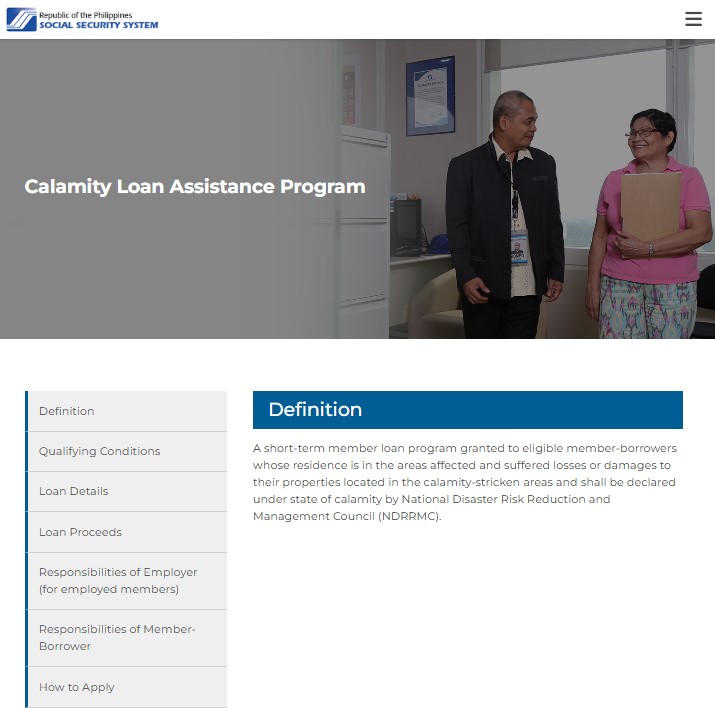
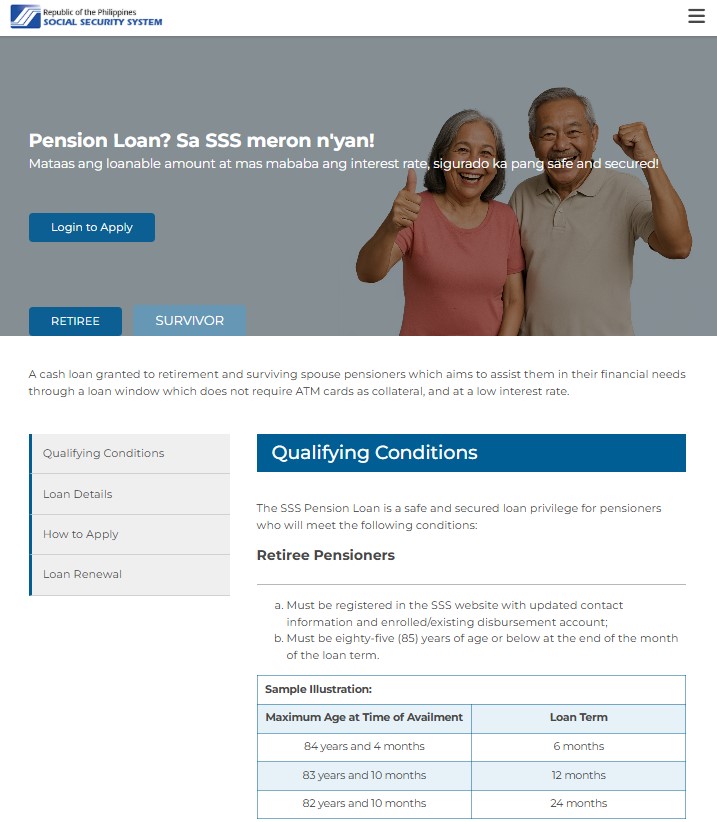
The SSS Pension Loan Program is for qualified retirement pensioners and certain surviving spouse pensioners who need cash for immediate financial needs.
This is not for ordinary active members. It is specifically for pensioners who meet SSS conditions, including age limits, active pension status, and disbursement account requirements.
SSS may also open or maintain other loan-related programs, such as:
These are not always the first option for ordinary borrowers. Some are available only under specific conditions.
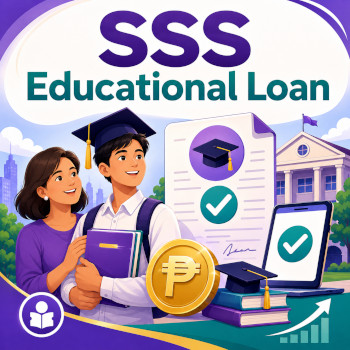
Also, many people search for SSS educational loan. Older content online may still mention an educational assistance loan, but members should not assume that a study loan is currently open just because they saw it in an old article. Always check current SSS announcements and active loan pages before relying on that information.
| Loan type | Best for | Who can apply | Basic idea |
|---|---|---|---|
| Salary Loan | Short-term personal cash needs | Qualified active members | The most common SSS member loan |
| Calamity Loan | Members affected by declared calamities | Qualified members in calamity areas | Emergency cash after disaster |
| Pension Loan | Pensioners needing extra cash | Qualified retirement or eligible survivor pensioners | Low-interest loan tied to pension |
| Emergency / special programs | Relief or restructuring | Depends on SSS program rules | Only when SSS opens the program |
The answer depends on the type of loan.
For the Salary Loan, SSS allows applications from:
For the Calamity Loan, you must also be a resident of a calamity-declared area and must have suffered losses or damage to your property.
For the Pension Loan, you must be a qualified pensioner and meet the age, pension status, and account requirements set by SSS.
In all cases, SSS does not approve a loan just because you are a member. Your contributions, membership type, loan history, contact details, and disbursement account all matter.
Because this is the main loan most readers are looking for, it deserves special attention.
To qualify for an SSS Salary Loan, a member must meet these basic conditions:
You must have:
You must have:
You must also have:
To qualify, you must also:
If you are employed, your employer must also be updated in the payment of contributions and loan remittances.
A member may qualify for the Calamity Loan if the following conditions are met:
This loan is only available when SSS opens the program for specific disaster-hit areas.
The Pension Loan Program is for qualified retirement pensioners and certain surviving spouse pensioners.
For retiree pensioners, the basic conditions include:
If you are not yet a pensioner, this loan is not the right product for you.
The loan amount depends on the type of loan.
For the Salary Loan:
The amount is equal to the average of your 12 latest posted Monthly Salary Credits (MSCs), rounded to the next higher MSC, or the amount you applied for, whichever is lower.
The amount is equal to twice the average of your 12 latest posted MSCs, rounded to the next higher MSC, or the amount you applied for, whichever is lower.
This means your Salary Loan amount is not based only on your current salary. It is based on your posted Monthly Salary Credits in SSS records.
Also, the net loan proceeds may be lower than the approved amount because SSS may deduct:
For the Calamity Loan, the amount is equivalent to one Monthly Salary Credit, based on the average of the last 12 MSCs, rounded up to the nearest thousand, or the amount applied for, whichever is lower.
For the Pension Loan, the loanable amount depends on the pensioner’s aggregate monthly pension.
The options are based on multiples of the monthly pension:
The maximum loan amount is ₱300,000.
However, SSS also checks the pensioner’s Net Take Home Pension, which must remain at least 40% of the aggregate monthly pension.
Many borrowers focus only on the loan amount. That is a mistake. You also need to know the interest, the fees, and the repayment schedule.
For the Salary Loan:
For the Calamity Loan:
For the Pension Loan:
For most borrowers today, the main application channel is My.SSS.
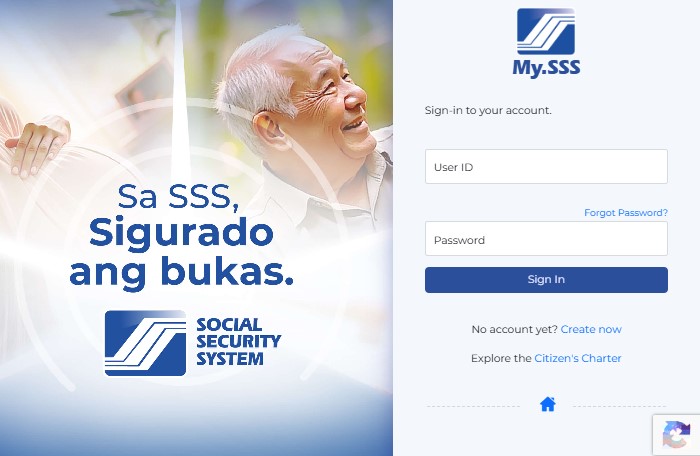
If you do not yet have a My.SSS account, set one up first. Many SSS loan services now depend on your online account.
For Salary Loan and Calamity Loan, online filing is the normal route.
Before applying, review your records:
A lot of rejected or delayed applications happen because members apply without checking their records first.
SSS requires an active disbursement account enrolled in the Disbursement Account Enrollment Module.
This step is crucial. Even if you are otherwise qualified, your loan cannot be released properly if your disbursement account is not valid or not enrolled.
Select the loan that matches your situation:
Do not apply for Calamity Loan unless your area is covered and you meet the calamity-related conditions.
Fill out the required details carefully. Make sure your personal data matches your SSS records.
For employed members, the employer may need to electronically certify the application through the employer’s My.SSS account.
After submission, save any confirmation or reference details shown on screen.
For employed members, processing may depend not only on SSS but also on employer certification and employer compliance with contribution and loan remittance rules.
The release method depends on the loan type, but for member loans SSS generally uses enrolled disbursement channels.
For the Salary Loan, proceeds may be released through:
This is why the disbursement account setup should be completed before you apply.
SSS does not make sense as a “file it and forget it” transaction. You should actively monitor the application.
Here is the practical way to check your SSS loan status:
Your My.SSS account is the main place to review your application, loan records, and payment records.
SSS uses your registered email and mobile number for notices, billing, and payment confirmations. If your contact details are outdated, you may miss important updates.
If the application is approved but your account setup has a problem, loan release may be delayed.
For loan repayment, SSS uses a Payment Reference Number (PRN). After payment, wait for the payment notification sent to your registered mobile number and email address.
If the status has not changed for a long time, or if you suspect a problem with employer certification or account details, you may contact SSS through:
Short-term SSS loan payments use a PRN.
This applies to loans such as:
For individual members, paying without the proper PRN can create posting issues, so it is better not to skip this step.
If you are employed, your employer has a role in the loan process.
The employer is expected to:
As a member, you are responsible for:
Even if your employer remits by payroll deduction, it is still wise to monitor your loan record yourself.
A lot of members assume that once they apply, approval is automatic. It is not.
Here are the common reasons for delay or rejection:
This is why checking your records first can save a lot of time.
Many Filipinos compare SSS loans with lending apps or private online lenders. They are not the same.
| Criteria | SSS Loan | Private Online Loan |
|---|---|---|
| Who can apply | Qualified SSS members or pensioners | Depends on lender |
| Basis of approval | SSS membership, contributions, records, loan history | Income, identity, lender policy |
| Cost | Usually more structured and often cheaper than many quick cash apps | May be faster but can cost more |
| Release | Through approved SSS disbursement channels | Depends on lender |
| Best for | Members with enough contributions and proper records | Borrowers who are not qualified for SSS or need another option |
| Risk | Delay if your records or employer compliance are not in order | Higher charges or poor terms if you do not compare carefully |
If you are not qualified for an SSS loan, compare alternatives carefully and check the total repayment amount, not just the advertised monthly figure.
If your application does not push through, do not immediately jump into the first lending app you see.
First, find the real reason.
Continue paying contributions and wait until you meet the minimum requirement.
Update your account details and make sure recent payments are correctly posted.
Follow up with HR or payroll. For employed members, employer compliance matters.
You may need to settle the loan or fix the account issue first before applying again.
Possible alternatives include:
The key is to compare carefully and avoid borrowing at terms you cannot realistically repay.
Before you file your SSS loan application, do this quick check:
The most common SSS loan is the SSS Salary Loan. It is the standard short-term loan for qualified members who need cash for personal expenses.
For a one-month salary loan, you need at least 36 posted monthly contributions, with 6 posted within the last 12 months before the month of application. For a two-month salary loan, you need at least 72 posted monthly contributions, with 6 posted within the last 12 months.
Yes, voluntary members may apply for the Salary Loan if they meet the contribution requirements. They must also have at least 6 posted monthly contributions under their current membership type before the month of application.
Yes, land-based OFW members may apply for certain SSS loans such as the Salary Loan if they meet the contribution and current membership-type requirements. They also need an active enrolled disbursement account.
For the Salary Loan, the amount is based on your latest posted Monthly Salary Credits, not just your current salary. A one-month loan is based on the average of your 12 latest posted MSCs, while a two-month loan is twice that average, subject to SSS rules and deductions.
The Salary Loan generally carries 8% interest per year for initial applications and some renewals, and 10% per year for renewals if the borrower previously availed of penalty condonation within the past five years. SSS can also adjust rates for new or renewed loans based on official policy.
The Salary Loan is payable in 24 equal monthly amortizations. Amortization starts on the second month after loan approval.
You apply through My.SSS. Before filing, check your contribution record, update your contact details, and make sure you have an active disbursement account enrolled in DAEM.
Log in to My.SSS to review your loan records and updates. Also monitor your registered email and mobile number for notices from SSS.
DAEM stands for Disbursement Account Enrollment Module. This is where you enroll the bank or approved account that SSS will use to release your loan proceeds.
No. The SSS Calamity Loan is available only when SSS opens the program for areas officially declared under a state of calamity. You must also be a qualified resident of the affected area and meet the contribution requirements.
Common reasons include insufficient posted contributions, past due loans, wrong or outdated account information, lack of employer compliance, ineligible age, missing disbursement account, or applying for a loan type you do not actually qualify for.
SSS uses a PRN for loan payments. You can generate the PRN through My.SSS and pay through SSS-accredited payment channels. After payment, wait for the posting confirmation sent to your registered mobile number or email.
Some older content online still mentions an educational assistance loan, but you should not rely on outdated articles. If you are looking for an educational loan through SSS, check the current active loan pages and official announcements first to confirm whether such a program is currently available.
Interest |
Loan amount |
Term |
Borrower age |
SEC registered |
||
|---|---|---|---|---|---|---|

|
APR 145%
|
₱500 — ₱20,000
|
from 3 to 6 months
|
22+ years
|
SEC Registration number: CS201953073., Certificate of Authority №1254
|
|

|
from 0%
|
₱1,000 — ₱50,000
|
up to 12 months
|
20 — 70 years
|
SEC Registration No. CS201908275 SEC Certificate of Authority No. 1324
|
|

|
APR 143% per year
|
₱1,000 — ₱20,000
|
from 61 to 183 days
|
22 — 70 years
|
Registration № CS201726430, CA №1181
|
|